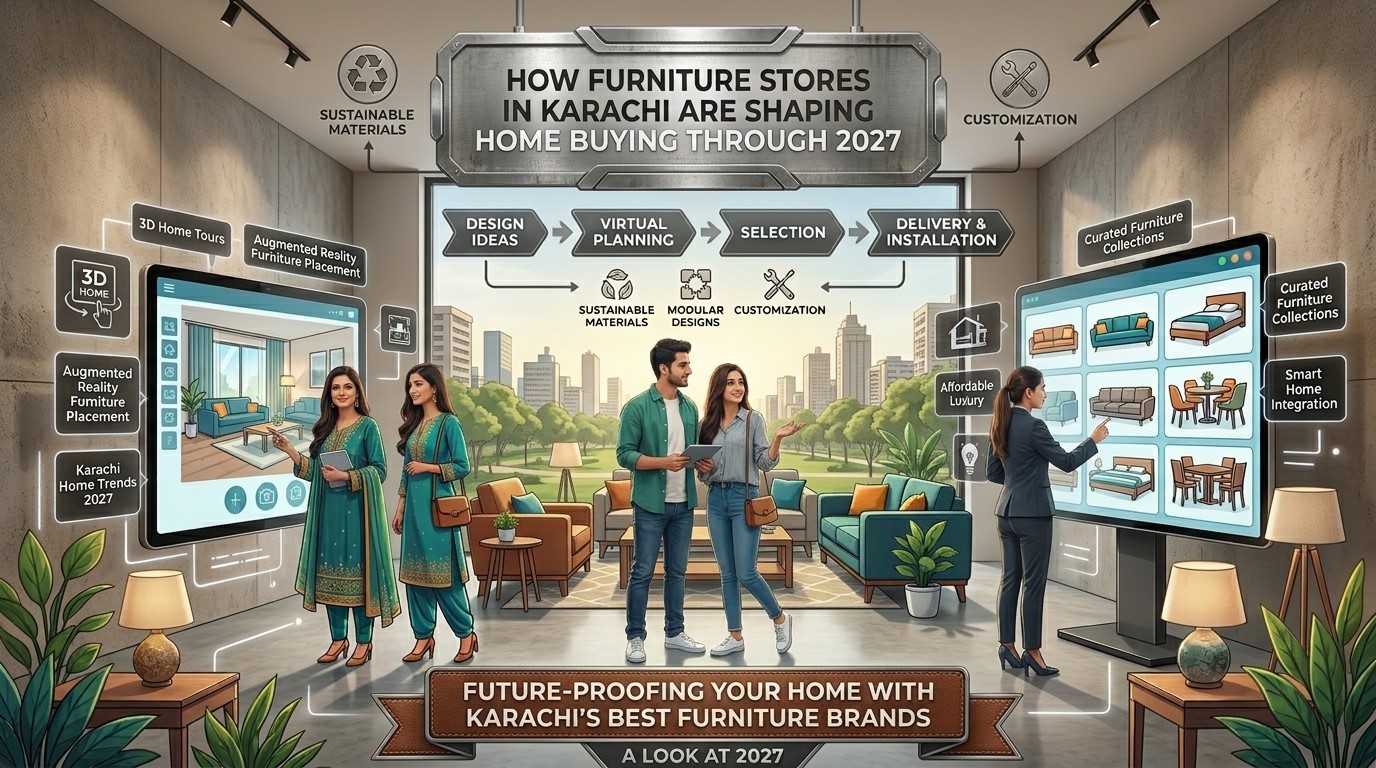
Karachi does not have a furniture industry so much as several of them, operating side by side and often overlapping. A buyer can commission a bed from a neighborhood carpenter who sketches the design on a scrap of paper, order a wardrobe from a showroom with a printed catalog and a written warranty, or scroll through a social media page and have a bedroom set delivered in a few days. All three routes are legitimate, and each carries its own risks and rewards.
For a city of this size, with high-rise apartments, older bungalows, and fast-growing housing schemes, the question “where should I buy furniture?” has no single answer. It depends on budget, timeline, room dimensions, and how much risk the buyer is willing to carry.
The Shape of the Market
Furniture stores in karachi retail can be understood as five overlapping channels. Most households end up using more than one.
1. Traditional wholesale and retail clusters
Concentrations of furniture shops and workshops have long served the city, offering a wide range of beds, wardrobes, sofas, dining sets, and dressing tables in a compact geographic area. Prices here are often negotiable, and many pieces are made to order or modified on request. The appeal is obvious: lower overheads, direct access to makers, and flexibility on size and design.
The trade-offs are equally clear. Quality varies sharply from one shop to the next, material specifications are frequently verbal rather than written, and after-sales support can depend entirely on whether the seller still operates from the same address a year later. Buyers who do well in these markets are usually those who arrive prepared, with measurements, reference images, and a clear sense of what they are willing to pay for.
2. Neighborhood workshops and individual carpenters
Skilled carpenters working from small workshops remain a backbone of the city’s furniture supply. Many specialize in solid wood, carving, or upholstery, and many are trusted through personal referrals passed between relatives and neighbors. For custom work, particularly pieces designed around an awkward room or a specific family request, this channel can deliver excellent results.
The limitations are consistency and accountability. Without standardized finishing, written warranties, or formal delivery arrangements, the buyer relies heavily on trust. When trust is well placed, the outcome can be superb. When it is not, there is rarely a formal recourse.
3. Branded showrooms
Over the past decade, branded furniture stores have multiplied across Karachi’s main commercial corridors and residential neighborhoods. These retailers offer displayed collections, consistent finishes, fixed pricing, and structured after-sales services. For buyers who value predictability, this is the most comfortable channel.
Branded does not automatically mean better, however. Some showrooms invest heavily in presentation while sourcing mid-grade materials, and some offer warranties that are narrower than they first appear. The brand’s name is a starting point for evaluation, not a substitute for it.
4. Multi-brand and department-style outlets
Larger stores and multi-category retailers stock furniture alongside home décor, mattresses, and appliances. They offer convenience, since a household can furnish several rooms in one visit, but their furniture range can feel generic, and staff often lack deep product knowledge on any single category.
5. Online and social-media-first sellers
A growing share of furniture discovery now happens on screens. Facebook and Instagram pages, marketplace listings, and brand websites have made it easy to browse hundreds of designs from a phone. Some sellers are established brands with physical showrooms; others are small operations that exist primarily online.
This channel rewards convenience and range, and it punishes carelessness. A photograph can be edited, borrowed, or staged to flatter a product that looks quite different in person. Buyers who use this channel successfully tend to treat photographs as an invitation to inquire, not as proof of quality.
Where the Stores Are
Karachi’s geography shapes its retail. The city stretches across hundreds of square kilometers, and traffic can turn a cross-town trip into a half-day commitment. As a result, furniture stores tend to cluster along major arteries and within large residential districts, so that customers do not have to travel far.
Established neighborhoods such as Defence, Clifton, Gulshan-e-Iqbal, North Nazimabad, and Gulistan-e-Jauhar each have their own concentrations of showrooms and workshops, and newer developments along the Super Highway and in schemes such as Bahria Town are attracting furniture retailers of their own as populations grow. Buyers living in newer areas often find that the nearest strong selection is still a significant drive away, which has made delivery capability and online browsing far more important than they were a decade ago.
For buyers, the practical consequence is simple: a store’s location matters less than its ability to deliver, install, and service furniture reliably across the city. A showroom in a prestigious address that cannot manage a delivery to a fourth-floor apartment without a lift is, for that buyer, a poor choice.
Traditional Markets Versus Branded Stores: An Honest Comparison
Buyers often frame the choice as “cheap and risky” versus “expensive and safe.” The reality is more nuanced.
Price. Traditional markets can offer lower prices, particularly for solid wood and made-to-order pieces. Branded stores generally charge more, reflecting showroom costs, marketing, warranty provisions, and service infrastructure. But a lower price is only a saving if the piece lasts. A bed that needs repair or replacement within a few years is not cheaper than one that costs more upfront and endures.
Customization. Traditional workshops often have the edge on flexibility, since they can adapt dimensions and details on the spot. Many branded stores now offer customization too, though it may be limited to selected sizes, fabrics, and finishes.
Transparency. Branded stores usually provide fixed price tags, catalogs, and sometimes written specifications. Traditional markets rely more on negotiation and verbal assurances.
Accountability. This is where the gap is most visible. A branded retailer with an established showroom has a reputation and a physical presence to protect. A workshop’s accountability rests on personal relationships.
Time. Ready-stock items from branded stores can be delivered quickly. Custom work from traditional makers may take weeks, depending on the workload and the complexity of the piece.
Neither route is universally superior. Many savvy buyers use both: they visit traditional markets to understand materials and price ranges, then compare against branded offerings before deciding where the balance of value, risk, and convenience falls for their particular purchase.
Specialists and Generalists
One of the more telling distinctions in Karachi’s furniture retail is between stores that sell everything and stores that sell one category exceptionally well.
General furniture stores carry sofas, dining sets, office furniture, bedroom sets, and décor. Their strength is breadth. Their weakness is that depth of expertise rarely extends across every category.
Specialist retailers, by contrast, concentrate on a specific room or product type. A bedroom furniture brand, for example, can spend its design and manufacturing effort on a narrower set of questions: how tall a headboard should be for a particular bed size, how drawer runners should be specified for heavy daily use, how a wardrobe should be proportioned for a compact apartment bedroom, and how a full set should be coordinated so that every piece looks as though it belongs to the same room.
That is the logic behind JF Homes’ focus on bedroom furniture. The bedroom is the room where Karachi households tend to concentrate their most careful spending: it is used every day, it is private, and it is central to wedding purchases. A store that does one thing deeply is often better placed to get the details right than one that does everything adequately.
None of this means specialists are always the right choice. A household furnishing an entire home may reasonably combine a specialist for the bedroom with other sources for living and dining areas. The point is that expertise matters, and buyers should ask whether a store’s staff can discuss construction and materials in specifics, not generalities.
What a Good Furniture Store Actually Does
The glossy showroom is the least informative part of a furniture store. What distinguishes a strong retailer from a weak one is a set of practices that are often invisible on a first visit.
It answers material questions precisely
Ask what the frame is made of, and the answer should be specific: the type of wood or board, the thickness, and how the corners and joints are constructed. Vague phrases such as “premium quality” or “best material” are not answers. A knowledgeable salesperson should be able to explain the difference between solid wood, veneered engineered board, and laminated board without discomfort, and should be honest about where each is appropriate.
It shows what is behind the display
A confident store lets customers open drawers, look inside wardrobes, inspect the underside of a bed, and examine the unfinished back of a panel. These are the areas where shortcuts are most easily spotted. A store that discourages this kind of inspection is telling you something.
It provides written terms
Warranty duration, what it covers, what it excludes, how repairs are handled, and who to contact should all be available in writing before payment. Verbal promises are easily forgotten, disputed, or lost when staff change.
It plans delivery properly
Good stores ask about doorway widths, stairwells, and lift access before confirming an order. They explain whether delivery and assembly are included, who carries the pieces upstairs, and how long the process will take. Poor delivery planning is one of the most common sources of customer frustration and avoidable damage.
It stays reachable after the sale
The real test of a furniture store comes after the invoice is paid. When a drawer sticks, a hinge loosens, or an upholstered panel sags, how quickly does the store respond? Retailers who invest in service teams, spare parts, and clear complaint channels signal that they intend to be around for a long time.
Climate: The Specification Showrooms Don’t Show
Any serious discussion of furniture stores in Karachi must address the climate. The city’s humidity, heat, and coastal salt air test materials relentlessly. Air-conditioned showrooms, ironically, tend to hide the problems that appear once furniture moves into a home that is only intermittently cooled.
Common failures include warped wardrobe doors, swollen board edges, peeling laminates, clouded finishes, and rusted hinges or drawer runners. Most of these trace back to a handful of causes: poorly seasoned timber, low-grade boards without moisture resistance, unsealed edges, and inexpensive hardware.
Buyers can protect themselves by asking pointed questions:
- How has the wood or board been treated for humidity?
- Are all exposed edges sealed?
- What is the hardware made of, and is it suited to coastal conditions?
- Has the finish been tested for scratch and stain resistance?
Stores that have thought carefully about Karachi’s conditions will answer without hesitation. Those that have not will often redirect the conversation to appearance and price.
Browsing Online, Verifying Offline
The shift to online discovery is arguably the most significant change in Karachi’s furniture retail over the past several years. Buyers now save reference images, compare finishes across brands, read comments, and arrive at showrooms with a specific look in mind. This has raised expectations for transparency and widened the field of competitors that any single store faces.
It has also created new risks. Photographs can be edited, lighting can flatter a mediocre finish, and images are sometimes borrowed from other sellers or from international catalogs. A few sensible habits reduce the chance of disappointment:
- Insist on seeing the real piece. Visit the showroom or workshop, or request a live video of the actual item rather than catalog images.
- Check for a physical address and consistent contact details. Pages that exist only as a profile and a phone number deserve extra caution.
- Ask for samples. Fabric and finish swatches viewed in your home’s own light are far more reliable than a screen.
- Read the order terms carefully. Understand advance payment requirements, delivery timelines, and what happens if the item arrives different from what was shown.
- Look for evidence of past customers. Genuine, specific feedback from verifiable buyers is more useful than a page full of generic praise.
The strongest retailers combine both worlds: an online presence that makes discovery easy and a physical showroom or service channel that makes verification possible.
Price, Payment, and the Economics of Value
Furniture prices in Karachi have risen along with the cost of timber, boards, fabrics, imported fittings, and transport, and buyers are understandably more cautious than they were a few years ago. In this environment, how a store handles pricing says a great deal about its character.
Fixed versus negotiable pricing. Traditional markets run on negotiation; branded stores generally post fixed prices, sometimes with seasonal promotions. Buyers should be wary of both extremes: an opening price so inflated that a 40 percent discount looks like a bargain, and a “sale” that appears permanently.
Cost per year of use. The most useful way to compare furniture is not the sticker price but the expected lifespan. A well-built bed that stays sound for fifteen years costs less per year than a cheaper one replaced twice in that time.
Payment terms. Many stores require an advance payment for made-to-order items, which is reasonable. Buyers should clarify how much is due upfront, when the balance is payable, and what happens if delivery is delayed or the product does not match the agreed specification. Receipts and written order confirmations are essential.
Hidden costs. Delivery, assembly, upholstery upgrades, and lift or stair carrying charges can add materially to the final bill. Asking for an all-inclusive quotation avoids unpleasant surprises.
Retailers who explain pricing openly, including what drives the cost of a particular piece, tend to build the kind of repeat and referral business that sustains a brand in a city where reputation spreads quickly through families and social circles.
Delivery, Installation, and the Last Mile
In a city with congested roads, narrow lanes, and apartment buildings of varying design, delivery is not a minor logistical detail. It is a core part of the product.
Large pieces such as wardrobes and bedsteads often have to be carried upstairs, rotated through tight corners, or assembled inside the room. A store that sends untrained staff, or fails to confirm measurements in advance, can damage both the furniture and the property.
Good retailers address this by:
- Confirming doorway, lift, and stairwell dimensions before dispatch.
- Using modular or knock-down designs where appropriate, so that large items can be moved in sections.
- Assigning trained installers who assemble and check each piece on site.
- Inspecting furniture with the customer at delivery and documenting any issues immediately.
Buyers should also inspect the delivery on arrival, check for transit damage before signing off, and test drawers, doors, and moving parts. Problems noted at the time of delivery are far easier to resolve than those raised weeks later.
Wedding Season and the Seasonality of Demand
Karachi’s furniture retail is shaped by a distinctive rhythm. Wedding seasons drive some of the heaviest demand of the year, as families purchase bridal bedroom sets and furnish new homes. These purchases are emotionally significant and financially substantial, and families expect them to be flawless, cohesive, and long-lasting.
For stores, this seasonality creates pressure. Lead times stretch, workshops fill up, and delivery slots become scarce. Buyers planning around a wedding date are well advised to order early, confirm timelines in writing, and build in a buffer for delays. Retailers that manage peak season capacity honestly, rather than promising dates they cannot meet, preserve trust at the moments when it matters most.
How to Evaluate a Furniture Store: A Practical Framework
Whether visiting a showroom, a workshop, or a seller’s online page, buyers can apply the same set of questions.
- Is the information specific? Can the seller name the materials, finishes, and hardware used, in writing?
- Is the construction visible? Can you inspect joints, backs, undersides, and drawer interiors?
- Are the terms clear? Are warranty, repair, delivery, and payment conditions written down?
- Is the store accountable? Is there a physical address, a reachable service contact, and evidence of a track record?
- Does the store understand your space? Did they ask for measurements, access details, and room constraints?
- Is the price explained? Does the quotation itemize what is included?
- Does the piece suit Karachi’s climate? Have moisture, heat, and coastal air been considered in materials and hardware?
A store that answers most of these satisfactorily is likely to be a safe choice. A store that bristles at them is telling you what you need to know.
Red Flags Worth Heeding
Experienced buyers learn to recognize warning signs:
- Pressure tactics. “Today only” discounts that vanish if you step out to think.
- Evasive answers about materials, hardware, or origin.
- Reluctance to provide written terms, receipts, or warranties.
- Heavy discounts on supposed premium items, which may signal inflated list prices or compromised materials.
- Large advance payments demanded with no written order confirmation.
- Photos that do not match what is available in person, or sellers who cannot produce the actual piece for inspection.
- No physical presence or service channel for post-sale issues.
None of these automatically means a seller is dishonest, but each is reason to slow down and ask more questions.
Looking Ahead to the End of 2027
Several trends are likely to shape Karachi’s furniture stores through the end of 2027.
Compact and modular design will grow. As apartment living expands and floor areas shrink, demand for storage beds, sliding-door wardrobes, and multifunctional pieces will keep rising. Stores that design specifically for compact bedrooms will have an edge.
Local manufacturing will strengthen. Import costs, currency pressures, and delivery uncertainty are pushing buyers to look closely at what domestic manufacturers can offer. Capable local brands that combine solid craftsmanship with reliable service are well placed to gain share.
Omnichannel retail will become the norm. The line between online and offline will keep blurring. Buyers will research digitally, verify in person, and expect consistent information across both. Stores that treat their website, social presence, and showroom as a single experience will outperform those that treat them separately.
Customization will become a baseline. Choices over dimensions, fabrics, and finishes, once a premium service, are increasingly expected. Retailers who can offer made-to-order options without sacrificing delivery reliability will stand out.
Transparency will become a competitive advantage. As buyers grow more informed, stores that publish clear material specifications, written warranties, and honest pricing will win trust faster than those that rely on branding alone.
After-sales service will define reputations. In a market where word of mouth travels quickly, the stores that respond promptly when something goes wrong will earn the loyalty that advertising cannot buy.
Durability will move from implication to promise. Households facing higher prices will favor furniture that lasts, and stores will increasingly compete on longevity, repairability, and the ability to refinish or reupholster pieces over time.
The Bottom Line
Karachi’s furniture stores range from centuries-old craft traditions to modern showrooms and fast-moving online sellers, and there is no shortage of choice. What the market lacks, more often than variety, is verified information. The buyers who do best are those who measure first, ask specific questions, inspect what lies beneath the finish, insist on written terms, and think in terms of cost over years rather than price on the day.
For retailers, the lesson is the mirror image. In a city where trust is built through families, friendships, and word of mouth, the most durable competitive advantage is not the grandest showroom but the most reliable promise, kept consistently. For JF Homes and its peers, the task through the end of 2027 is to keep making that promise credible: bedrooms designed for Karachi’s spaces, built for its climate, delivered with care, and supported long after the sale.
Frequently Asked Questions
How do I choose a reliable furniture store in Karachi?
Look for a store that gives specific, written answers about materials, finishes, and hardware, allows you to inspect joints and unseen surfaces, and provides clear warranty and delivery terms. A physical address, a reachable service contact, and a visible track record with past customers are also strong signs of reliability.
What should I check before buying furniture from an online seller in Karachi?
Confirm that the seller has a verifiable address and consistent contact details, ask to see the actual piece in person or on a live video, request fabric and finish samples, and read the payment and return terms carefully. Avoid paying large advances without a written order confirmation.
Why is bedroom furniture often better bought from a specialist store?
A specialist concentrates its design and manufacturing effort on one room, so it can refine proportions, storage, finishes, and coordinated sets in ways a general store often cannot. This matters most for purchases such as wedding bedroom sets, where cohesion and durability are priorities.
How can I tell if a furniture store’s prices are fair?
Compare quotations from several stores on the basis of construction quality, materials, hardware, warranty, and delivery, not just the total. Be cautious of unusually large discounts, ask for an itemized all-inclusive quotation, and consider the cost per year of expected use rather than the upfront price alone.
What after-sales services should I expect from a good furniture store?
Expect a written warranty with clear coverage, professional delivery and installation, and defined options for repair, refinishing, or reupholstery. A good store also provides a reachable contact for service requests and a realistic response time, so that problems are resolved long after the purchase.