Most advice about bedroom furniture says “choose quality materials” and “measure your room.” That is true, but it does not help you decide between a hydraulic and a drawer storage bed, or tell you why a wardrobe that looked perfect in the showroom now smells musty in July. The decisions that change how a bedroom looks, feels, and lasts in Karachi: the climate, the materials, the sizes, the hardware, and the buying process.
Why Karachi is a Different Furniture Market
Bedroom furniture in Karachi designed for a dry, temperate climate behaves differently here. Four local conditions shape almost every purchase.
Humidity. Karachi’s coastal air stays moist for much of the year, and it peaks around the monsoon. Wood and board absorb that moisture, swell slightly, and release it again in drier months. Poorly dried or poorly sealed pieces warp, loosen at the joints, or develop bubbling finishes.
Salt in the air. Areas close to the sea, such as Clifton, DHA Phase 8, Korangi Creek side developments, and parts of Seaview, see salt-laden air that corrodes untreated metal. Hinges, drawer runners, and handles are the first places to show rust or pitting.
Fine dust. Construction, traffic, and dry winds leave a fine film on every surface. High-gloss finishes show it within hours, while matte and textured finishes hide it better.
Heat and power cuts. Long summers mean air conditioning runs hard when available, and fans and backup lighting matter when it is not. Rooms swing between cool and hot, which stresses wood. Direct afternoon sun through west-facing windows fades fabric and dries out finishes.
A piece that handles these four conditions well will outlast a better-looking piece that does not.
Start with the Room You Actually Have
Karachi bedrooms vary widely, and the best layout for one is wrong for another.
Compact apartment bedrooms (about 10 x 11 to 12 x 13 feet)
These are common in Gulshan-e-Iqbal, Bahadurabad, Clifton high-rises, and newer DHA and Bahria apartments. A king bed (around 72 x 78 inches) takes up roughly 6 x 6.5 feet, leaving little space for anything else. In these rooms:
- Choose a queen bed or a compact king with a low headboard.
- Use slim side tables (30 to 35 cm wide) or wall-mounted shelves instead of bulky cabinets.
- Pick a sliding-door wardrobe, because hinged doors need about 50 to 60 cm of swing space.
- Choose a storage bed to replace a separate chest of drawers.
- Keep colours light to reflect what natural light the room receives.
Mid-sized bedrooms (about 12 x 14 to 14 x 15 feet)
These rooms are the easiest to furnish. A king bed, two matching side tables, a wardrobe along one wall, and either a dresser or a small seating corner fit comfortably. The risk here is overbuying, so leave at least 60 cm of walking space on each open side of the bed.
Bungalow master bedrooms (16 x 18 feet and larger)
The problem in large rooms is proportion. A standard king bed with a short headboard looks small against a big wall. A tall upholstered headboard, a bench at the foot of the bed, a full dressing unit, and a reading chair give the room a deliberate shape. Ceiling height also matters, since tall headboards and wardrobes look best with ceilings above ten feet.
Children’s and shared rooms
Durability comes before style. Look for rounded corners, scratch-resistant laminate or PU finish, beds with built-in storage, and wardrobes with lower shelves that children can reach. If two children share a room, a bunk or loft bed with a sturdy ladder and guard rails saves floor space, but check the weight rating and the rail height.
Guest rooms
A guest room needs a comfortable bed, a small wardrobe or rail, and a side table. Do not overspend here. A queen bed with a good mattress and simple storage serves guests better than a large set that crowds the room.
The Order in Which to Buy
Many buyers begin with a piece they love, such as a dressing table, and then find that the bed and wardrobe do not fit around it. A more reliable order is:
- Bed frame and mattress. It is the largest piece and fixes the layout.
- Wardrobe. It needs fixed clearance for doors and cannot be moved easily later.
- Side tables. Choose these to match the height and width of the bed.
- Dresser or dressing table. Fit it into the remaining wall space.
- Accent pieces. A bench, chair, shelf, or mirror comes last.
Buying in this order also spreads the spending, which helps if you are furnishing over several months.
Set or Separate Pieces: A Practical Comparison
A matching set gives a coordinated look, saves decision time, and guarantees that the match finishes. It suits first apartments, guest rooms, and buyers who want a quick, clean result. The trade-off is that you must accept every piece in the set, including ones you may not need.
Separate pieces let you size each item for your room, replace one piece without redoing everything, and mix materials for a layered look. They suit awkward rooms and buyers with strong preferences. The trade-off is that coordination takes more care. A simple rule is to choose one dominant wood tone and limit other finishes to one or two shades.
A hybrid approach often works best: buy the bed and side tables as a matching group, then choose the wardrobe separately to fit the wall.
Materials Explained: What Each One Does in Karachi
“Solid wood” is the most overused phrase in furniture marketing, and it often hides more than it reveals. Here is what each material means in practice.
Solid wood
Sheesham (Indian rosewood), mahogany, teak, and oak are common. Solid wood is strong, can be sanded and refinished, and holds screws well. In humid climates, however, its performance depends on how it was seasoned. Kiln-dried timber has a controlled moisture content and stays stable. Air-dried or poorly dried timber continues to move, which leads to cracks, gaps at joints, and warped panels. Ask where the wood is sourced, how it was dried, and what sealant was used.
Solid wood suits bed frames, side rails, legs, and structural supports, where strength matters most.
Veneered engineered board
A thin slice of real wood is glued over a stable core such as plywood or high-grade board. Because the core is stable, a good veneered panel resists warping better than cheap solid wood. It suits wide flat surfaces such as wardrobe doors, headboards, and dresser tops. Check that the veneer is thick enough to sand lightly if needed, and that the edges are sealed.
Plywood
Layers of thin wood laid in alternating directions give plywood good strength and stability. Marine or moisture-resistant grades handle humidity well. It is often used for wardrobe carcasses and bed bases, and it holds screws better than MDF.
MDF (medium-density fibreboard)
MDF is smooth, takes paint evenly, and allows shaped or routed designs. Standard MDF absorbs water through unsealed edges and swells permanently. Moisture-resistant MDF performs better, especially when edges are banded and sealed. Avoid standard MDF for ground-floor rooms, sea-facing apartments, and anywhere near a bathroom wall.
Particle board
It is the lowest-cost board, and its performance depends heavily on quality. Good laminated particle board with tight edge banding can last in a dry upper-floor room. In humid conditions it is the most vulnerable material, so use it only for low-stress items.
Metal and mixed frames
Metal bed frames are slim and durable, and suit modern interiors. Check welding quality, powder-coat finish, and whether the frame has a centre support for king sizes. Untreated or thinly plated steel will corrode near the coast.
A sensible combination
A well-built bedroom furniture in karachi often uses solid or high-grade wood for the bed frame, sealed veneered board or plywood for the wardrobe, and quality laminate or PU-finished board for drawers and side tables. Ask for the material of each piece in writing, rather than accepting a general claim.
Finishes: Where Durability Is Often Won or Lost
Two pieces made from identical boards can age very differently depending on finish.
PU (polyurethane) lacquer forms a hard, water-resistant coat. Multi-coat PU gives the best protection against spills, rings from glasses, and daily handling. It suits side tables, dressers, and bed frames.
Matte and satin finishes look soft and modern. They hide fingerprints and fine dust, and they are the practical choice for Karachi homes.
High-gloss finishes reflect light and make small rooms feel brighter. However, they show dust, smudges, and micro-scratches quickly. If you choose gloss, expect more frequent wiping with a soft microfibre cloth.
Open-grain or natural oil finishes keep the wood’s texture and feel. They need more care and periodic re-oiling.
Laminates are durable and affordable. They suit wardrobes, children’s furniture, and rental homes. Quality depends on the edge banding, since peeling usually starts at the edges. Press along the edges in the showroom to check that the bond is firm.
Paint finishes allow any colour but can chip at corners. They suit decorative pieces more than high-contact surfaces.
Hardware: The Small Parts That Decide Longevity
Many furniture complaints trace back to hardware rather than the main structure.
- Hinges. Soft-close hinges prevent slamming and reduce stress on door edges. Cheap hinges loosen over time and cause doors to sag.
- Drawer runners. Full-extension, soft-close runners let you reach the back of a drawer and carry heavier loads. Basic roller runners wear and stick sooner.
- Handles and pulls. Brass, zinc alloy, and stainless steel resist corrosion. Gold-coloured coatings on thin steel can flake.
- Bed fittings. Look for metal brackets and bolts at the frame joints, not only wooden dowels. For storage beds, hydraulic lift mechanisms should have a stated load rating.
- Screws and fixings. Zinc-plated or coated screws resist rust in humid air.
When comparing two similarly priced wardrobes, the one with better hinges and runners usually gives longer trouble-free use.
Choosing the Right Bed
Size
Local sizes are inconsistent, so check exact dimensions rather than relying on the label.
| Bed type | Typical mattress size | Best for |
| Single | About 36 x 75 in | Children, guest rooms |
| Double | About 54 x 75 in | Compact rooms, one adult |
| Queen | About 60 x 78 in | Small couples’ rooms |
| King | About 72 x 78 in | Most couples’ rooms |
Always confirm the frame’s internal measurements against the mattress. A one-inch mismatch causes slipping and uneven wear.
Storage type
Hydraulic lift-up storage opens the whole base and holds large items such as quilts, suitcases, and seasonal bedding. Check the lift mechanism’s rating and the depth of the compartment.
Drawer storage is easier for daily items but requires floor clearance on the sides. It suits rooms where the bed is placed against one wall and the drawer side has open space.
Platform beds with no storage have a cleaner look and are lighter. They suit buyers who already have enough wardrobe space.
Slats and support
Slats should be spaced under 7 cm apart so foam and spring mattresses are supported evenly. Wide gaps can void some mattress warranties. King-size frames need a centre support beam, otherwise the middle will sag over time. Solid platform bases offer the most even support but reduce airflow, which can trap moisture under the mattress in humid months. Slatted bases with proper spacing allow air to circulate.
Headboard
Wooden headboards are the easiest to maintain and wipe clean.
Upholstered headboards are comfortable for reading in bed. Choose a tight-weave or performance fabric, since light, loose weaves stain easily.
Padded panels with removable covers offer a middle route, especially in homes with children.
Make sure the headboard is joined to the frame with bolts or brackets and not only attached to the wall, because wall-only fixing becomes loose over time.
Mattress Compatibility and Why It Matters
A frame and mattress should be bought as a pair or checked together. Mattress thickness affects how high the bed sits. A 12-inch mattress on a frame with a high headboard and deep side rail can look sunken, while a thin mattress on a tall platform looks lost. Foam, hybrid, and pocket-spring mattresses also behave differently. Foam needs even support, pocket-spring needs good slat spacing, and heavier mattresses need a stronger frame. Ask the store whether the frame was designed for the mattress you plan to use.
Wardrobes: The Most Underestimated Purchase
A wardrobe is usually the biggest and most used piece in the room, and the one buyers think about least.
Doors
Sliding doors save floor space and suit compact rooms, but only half the wardrobe is accessible at a time. Check the track quality, since cheap tracks jam with dust.
Hinged doors give full access to the entire interior. They need clearance, about 50 to 60 cm per door width, and they suit mid-sized and large rooms.
Mirrored doors save buying a separate mirror, but they show fingerprints and add weight to the hinges.
Interior layout
Interior planning matters more than exterior style. Think about what you hang and what you fold.
- Long garments. Shalwar kameez, abayas, and sarees need about 140 to 150 cm of hanging height. A standard 100 cm rail forces them to fold or drag.
- Short hanging. Shirts and jackets need about 100 cm, which allows a double-rail arrangement.
- Shelves. Adjustable shelves help when folded items vary in size.
- Drawers. Shallow drawers organise accessories, scarves, and undergarments. Deep drawers suit knitwear.
- Shoe space. A pull-out rack or bottom shelf prevents shoes from crowding the floor.
- Locker. A small lockable compartment is useful for documents and jewellery.
Humidity control
Closed wardrobes trap moist air. In monsoon months this leads to a musty smell and, in bad cases, mildew on clothes. Keep a small gap behind the wardrobe for airflow, use silica gel packs or moisture absorbers, and place cedar blocks or dried neem leaves inside to deter insects. Avoid packing the wardrobe so tightly that air cannot move.
Dressers, Side Tables, and Mirrors
Side tables should sit within a few centimetres of the mattress top height, so reaching for a glass of water or a phone is comfortable. One drawer and one open shelf give both closed and quick-reach storage. Rounded corners are safer in children’s rooms.
Dressers should be proportional to the bed. A useful guide is that the bed and two side tables together should occupy roughly two-thirds of the main wall, so the dresser has its own space on a different wall.
Dressing tables need a well-lit mirror, a comfortable stool, and enough knee space. A mirror with built-in lighting reduces the need for extra lamps, and drawers should be fitted with dividers for makeup and jewellery.
Mirrors placed opposite a window reflect daylight and make a room feel larger.
Power and cables. Karachi homes rely on chargers, fans, and backup lights, so bedside tables with integrated charging points or cable cut-outs prevent tangled extension cords behind the bed.
Choosing a Style That Fits Your Life
Modern minimalism uses clean lines, flat panels, concealed storage, and neutral colours. It suits apartments and buyers who want a calm room. The caution is that flat surfaces show warping and finish flaws more clearly.
Classic or traditional uses carved detail, rich wood tones, and structured headboards. It suits larger rooms and buyers who prefer a formal look. The caution is that heavy carving needs more dusting.
Transitional blends both: simple shapes in warm wood with a few classic details. It is the safest choice if you may redecorate later.
Upholstered contemporary features channelled or tufted headboards and soft textures. It suits buyers who want comfort and a hotel-like look. The caution is that fabric needs regular cleaning.
Pick a style that matches your habits, not only your taste. If you read in bed, an upholstered headboard helps. If you have young children or pets, a wipe-clean finish helps more.
Colour, Light, and Mood
Light-coloured furniture in warm neutrals such as cream, beige, and pale oak makes small rooms feel larger. Dark woods such as walnut and espresso look dramatic and suit larger, well-lit rooms, but they absorb light and show dust. Mid-tone woods hide both dust and scratches and work in most rooms.
Limit the main palette to three tones: one for the furniture, one for the walls, and one for textiles. Add colour through bedding, cushions, and curtains, because these are easy and inexpensive to change. Check colour samples in your own room at different times of day, since showroom lighting and home lighting differ.
Furnishing Children’s and Teen Rooms
Children’s furniture needs to survive heavy use and grow with the child.
- Choose rounded edges and stable bases.
- Pick scratch-resistant finishes, such as laminate or multi-coat PU.
- Favour beds with drawers underneath, which keep toys and clothes off the floor.
- For teens, add a desk with a ventilated chair, adequate lighting, and a bookshelf.
- Avoid very bright or trend-driven colours in large pieces, because tastes change quickly.
Planning Your Budget
Spending more does not always mean better value, but spending in the right places does.
Spend more on: the bed frame, mattress, wardrobe carcass, and drawer hardware. These carry loads, are handled daily, and are expensive to replace.
Save on: decorative items such as lamps, cushions, wall art, and rugs, which can be replaced later.
Compare two bedroom sets of similar size. One uses standard MDF with thin laminate, basic hinges, and a single-coat finish. The other uses moisture-resistant board with sealed edges, soft-close hardware, and multi-coat lacquer. The second costs more upfront, but if it lasts significantly longer in Karachi’s climate, its cost per year of use is lower.
Ask each shop for a written list of what the price includes: delivery, assembly, mattress, and warranty. A low price without these inclusions can end up costing more.
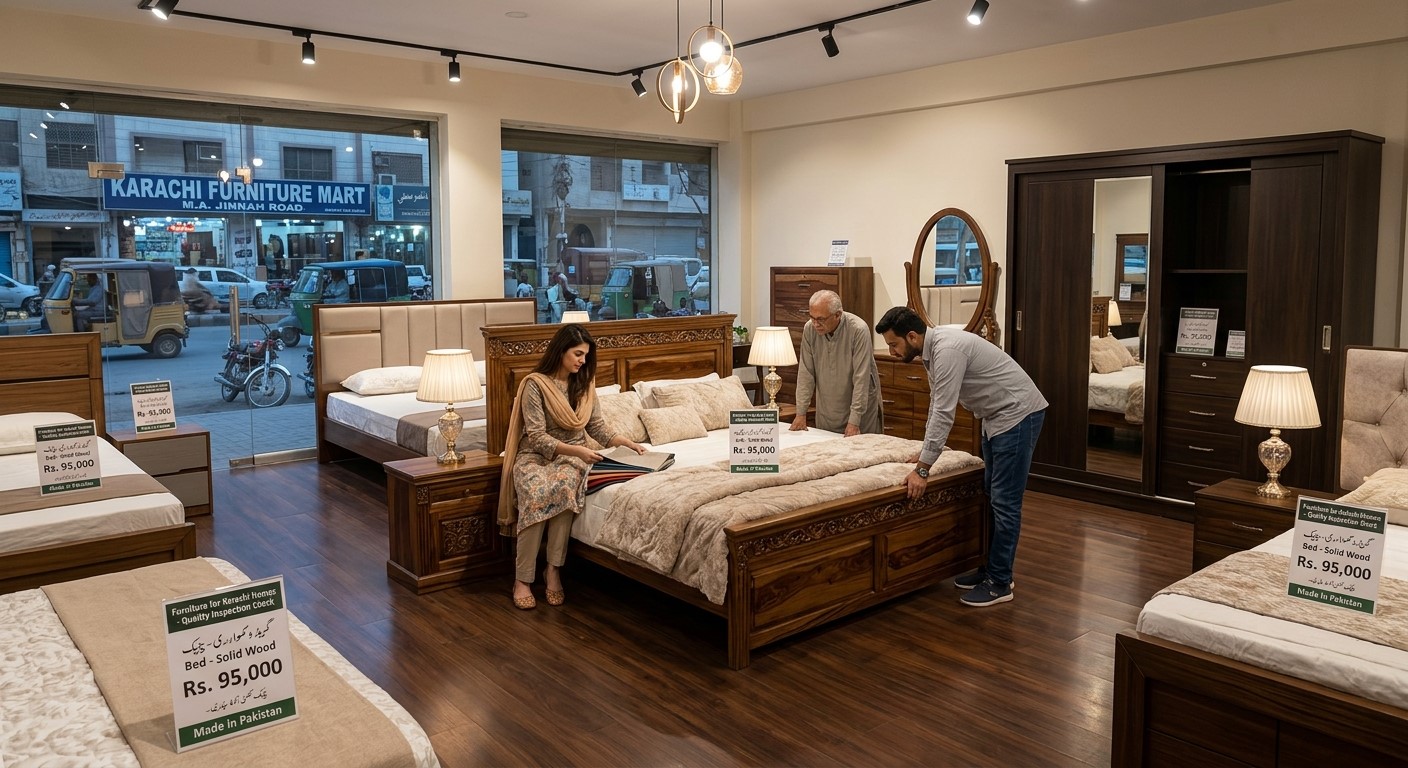
How to Inspect Furniture Before You Pay
A ten-minute inspection reveals more than any brochure.
- Open every drawer fully. It should glide without wobble and stop firmly.
- Open and close every door. Gaps should be even, and soft-close hinges should work smoothly.
- Push the wardrobe from the side. Excess flex suggests weak construction.
- Run a finger along the edges. They should feel smooth and sealed, not rough or lifting.
- Look underneath and behind. Finished interiors and solid back panels indicate careful work.
- Sit and lie on the bed. Shift your weight and listen for creaks.
- Check the finish in natural light, not only under showroom spotlights.
Ask for written specifications covering the core material, finish, hardware, and dimensions.
Delivery and Installation in Karachi
Large furniture has to reach your room before it can be used. Apartment lifts are often small, stairwells narrow, and building management may limit delivery hours. Before ordering, measure the lift interior and door opening, the stairwell turns, the main door, and the bedroom door. Share these with the seller.
Ask whether pieces arrive assembled or flat-packed, because flat-pack designs pass through tight spaces more easily. Confirm that delivery includes assembly, removal of packaging, and responsibility for any damage in transit. On arrival, inspect each item with the delivery team present, photograph any issue immediately, and note it before signing.
Caring for Your Furniture
Simple habits extend the life of good furniture.
- Dust weekly with a soft, slightly damp microfibre cloth, then dry it. Avoid heavy chemical sprays.
- Wipe spills immediately, especially on wood, laminate, and fabric.
- Keep furniture out of direct sunlight. Use curtains or blinds on west-facing windows.
- Control humidity. Run air conditioning or a dehumidifier during monsoon months, and ventilate the room when possible.
- Leave a small gap behind wardrobes and beds so air circulates.
- Tighten screws and bolts once a year, since seasonal movement loosens them.
- Clean upholstery with a vacuum brush monthly and treat stains early.
- Use coasters and mats under glasses, lamps, and decorative items.
How JF Homes Designs for Karachi
JF Homes builds its bedroom furniture around the conditions Karachi homes actually face: humidity, compact apartments, and heavy daily use. That means attention to edge sealing, finish quality, hardware selection, and clear specifications, so that the piece you inspect in the showroom is the piece that arrives at your door. Visiting in person lets you test the beds, open the drawers, compare finishes in your own light, and ask the questions in this guide directly.
Complete Your Bedroom by the End of 2027
If you plan to furnish a new home or refresh an existing bedroom, set a clear timeline that finishes by the end of 2027. Spend the first stage measuring your room, checking your lift and stairwell, and deciding your style and budget. Next, buy the bed, mattress, and wardrobe, which are the foundation of the room. Then add side tables, a dresser, and accessories in stages as your budget allows. A planned schedule keeps spending under control, avoids rushed decisions, and keeps the room cohesive. Visit JF Homes in Karachi to begin, and aim to have your bedroom complete well before the end of 2027.
Frequently Asked Questions
How do I choose the right bedroom furniture for a small apartment in Karachi?
Choose a queen or compact king storage bed with a low headboard, slim or wall-mounted side tables, and a sliding-door wardrobe. Leave at least 60 cm of walking space on each open side of the bed, and keep colours light so the room feels larger.
What is the best material for bedroom furniture in Karachi’s humid climate?
No single material wins everywhere. Well-seasoned solid wood works best for bed frames, while sealed veneered board, plywood, or moisture-resistant MDF suits wardrobes and large panels. Whatever the material, check that edges are sealed and the finish is a quality PU or laminate. Avoid unsealed standard MDF in ground-floor or sea-facing rooms.
Why does bedroom furniture warp, swell, or develop a musty smell here?
Karachi’s humidity causes wood and board to absorb moisture, especially through unsealed edges or poorly dried timber. Closed wardrobes trap that damp air and encourage mustiness. Proper seasoning, sealed edges, good finishing, airflow behind the furniture, and moisture absorbers inside wardrobes prevent most of these problems.
How can I make sure a bed and mattress fit together properly?
Confirm the frame’s internal dimensions in inches or centimetres and compare them with the mattress size, since local sizes vary by an inch or more. Check that slats are spaced under 7 cm apart and that king frames have a centre support beam. Ideally, buy and test the frame and mattress together.
What should I ask at a store before buying bedroom furniture?
Ask for the core material of each piece, the finish type, the hardware used, exact dimensions, what the warranty covers and for how long, and whether delivery includes assembly. Request these details in writing, and measure your lift, doors, and stairwell before ordering.